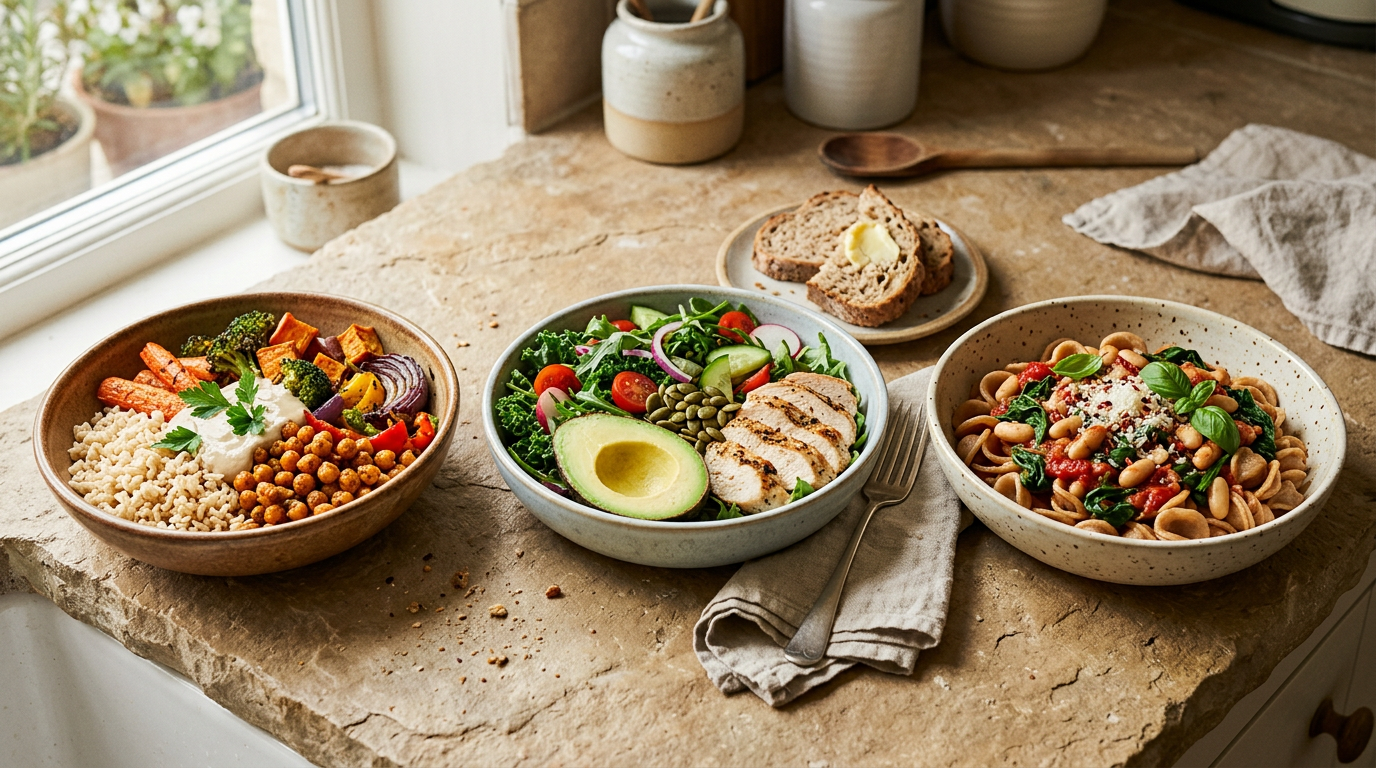
A balanced meal does not have to look the same every day. It might be a rice bowl assembled from leftovers, a sandwich with fruit, a familiar family dish, or a purchased meal that fits the day. The goal is to build a varied eating pattern that provides nourishment while accommodating real schedules, budgets, preferences, and household needs.
The mistake is treating balance as a rigid formula that every plate must satisfy. A more useful approach is to understand the roles different foods can play, recognize where variety may be missing over time, and keep several workable ways to put meals together.
This guide introduces a flexible meal-building framework, practical examples, and a simple method for reviewing your options without calorie counting, food guilt, or perfection rules.
Balance belongs to the eating pattern, not a perfect plate
One meal does not determine the quality of an entire eating pattern. Meals vary because schedules, appetite, food availability, cultural traditions, and individual needs vary.
Consider a breakfast of toast and fruit. It may be convenient and familiar, even though it does not contain every food group. Another meal may include beans, vegetables, rice, and a sauce. Looking across eating opportunities gives a broader picture than judging either meal in isolation.
The Dietary Guidelines for Americans, 2025–2030 emphasize nutrient-dense foods across several groups, including protein foods, vegetables, fruits, healthy fats, and whole grains. They also recognize different food sources within those groups.
That guidance provides useful context, but it does not mean every meal must contain every category in a prescribed arrangement.
For ordinary meal planning, begin with the question: What combination of familiar foods would make this eating opportunity workable and contribute to variety over time?
Build meals around complementary food roles
Instead of starting with a fixed recipe, think about the roles foods can serve. A food may contribute to more than one role, and many mixed dishes already combine several.
| Food role | Familiar examples | How it can fit |
|---|---|---|
| Protein sources | Beans, lentils, eggs, fish, poultry, tofu, yogurt, nuts, and seeds | Can contribute protein and other nutrients to meals and snacks. |
| Vegetables and fruits | Fresh, frozen, canned, or dried options | Add variety and provide different vitamins, minerals, and other nutrients. |
| Grains and other starchy foods | Oats, rice, bread, pasta, potatoes, and tortillas | Provide energy and can serve as a familiar foundation for meals. Whole grains also contribute fiber. |
| Foods contributing fats | Olive oil, avocado, nuts, seeds, and other familiar ingredients | Contribute dietary fats and may also provide other nutrients. |
| Dairy and suitable alternatives | Milk, yogurt, cheese, and appropriate fortified alternatives | Can contribute nutrients such as calcium and protein, depending on the product. |
This is a meal-building reference, not a requirement to select one item from every row at every meal. A bean-and-vegetable dish, for example, may already combine protein, vegetables, and other ingredients.
Some foods serve multiple roles. Nuts contribute protein and fat. Beans contribute protein and fiber. Dairy foods vary in their nutrient composition, and fortified alternatives are not all nutritionally equivalent.
Use these roles to recognize options, not to create another set of food rules.
Start with the meal you already know how to make
A flexible pattern does not require replacing familiar meals with unfamiliar recipes.
Begin with a meal you already prepare, assemble, or purchase. Identify the ingredients and food roles it includes. Then consider whether a practical addition or substitution would improve variety across your usual eating pattern.
For example, a familiar rice dish might already contain vegetables, beans, meat, eggs, or tofu. There is no need to separate everything into individual compartments to make the meal count.
A sandwich may include bread, a protein source, vegetables, and a spread. Fruit, yogurt, or another familiar food can be available alongside it when wanted and appropriate.
The point is not to make every meal larger or more complicated. It is to understand what is already present and where useful options may fit.
Three routes to a workable meal
A balanced-meal pattern becomes easier to maintain when it does not depend on cooking every time.
Consider three ways to reach a meal:
- Prepare: Cook a meal or reusable component when time and equipment are available.
- Assemble: Combine foods that are already available with little additional preparation.
- Purchase: Obtain a prepared meal when shopping, cooking, or assembling food is not realistic.
These routes are alternatives, not levels of achievement. A purchased meal is not automatically inferior to a home-prepared meal, and a meal assembled from convenient ingredients does not represent a failed cooking plan.
For example, a person with a variable work schedule might cook rice and vegetables on one evening, assemble a sandwich and fruit on another, and purchase dinner after a late shift.
The ingredients and preparation methods change. The broader intention to maintain access to varied food remains.
See how flexibility works across different meals
| Situation | Workable meal example | Flexible adjustment |
|---|---|---|
| Limited morning preparation time | Oatmeal with yogurt and fruit | Use familiar frozen fruit or another available topping. |
| Short lunch break | Sandwich with vegetables and fruit | Use a suitable prepared filling instead of cooking one. |
| Shared household dinner | Rice, beans, vegetables, and a familiar sauce | Let household members choose suitable additions or substitutions. |
| Low-energy evening | Frozen vegetables, a familiar protein source, and a convenient grain | Use ready-to-eat or quick-preparation ingredients. |
| Meal purchased away from home | A familiar mixed dish containing several food groups | Choose according to availability, preference, cost, and individual needs. |
These examples illustrate meal combinations rather than individualized nutrition prescriptions. The appropriate amount and composition of food depend on personal needs and circumstances.
Notice that the examples do not require identical ingredients, fixed meal times, or a particular cuisine.
Use substitutions without turning them into compromises
A useful meal pattern should tolerate changes in ingredient availability.
If fresh vegetables are unavailable, frozen or canned vegetables may be practical alternatives. If a preferred protein source is unavailable, another suitable option may serve a similar purpose. If cooking is unrealistic, an assembled or purchased meal may be appropriate.
Substitutions do not need to reproduce the original meal exactly. They need to be workable for the person eating them.
Check relevant differences when they matter. For example, food allergies require careful ingredient and cross-contact consideration. Fortified beverages may differ in protein and other nutrients. Medical restrictions may limit which substitutions are appropriate.
Flexibility should never override a genuine safety requirement.
Build variety across the week without creating a quota
Looking across several days can reveal whether the same narrow set of foods appears repeatedly or whether different food groups have reasonable opportunities to appear.
This does not require counting every serving or creating a weekly completion target.
Instead, consider a few practical questions:
- Are several familiar protein sources available across the week?
- Do vegetables and fruits have workable places in meals or snacks?
- Are suitable grain and other carbohydrate-containing foods available?
- Does the household have options that fit cultural preferences and individual needs?
- Can the pattern accommodate an unexpected schedule change?
If one area is difficult, identify an access or preparation adjustment rather than treating the week as incomplete.
The distinction between repeating a daily rule and maintaining a broader pattern is explored in daily rules versus weekly patterns.
Make the pattern affordable before making it elaborate
Cost can determine whether a meal pattern is realistic. A plan built around expensive specialty ingredients may be difficult to maintain even when the recipes are appealing.
Start with familiar foods the household already purchases and uses.
- Compare prices using quantities the household will actually consume.
- Consider frozen and canned options when they improve affordability or reduce waste.
- Use familiar staple foods as the foundation for several meals.
- Plan around available storage and cooking equipment.
- Include convenient backups rather than assuming every meal will be cooked.
A lower-cost option is useful only if it is accessible, appropriate, and likely to be eaten. Buying a large quantity of unfamiliar food does not necessarily save money when much of it goes unused.
Respect the way your household actually eats
Balanced eating does not require one national cuisine, one meal schedule, or one arrangement of ingredients.
Mixed dishes, soups, stews, grain bowls, sandwiches, wraps, and traditional family meals can all contribute to a varied eating pattern.
In a shared household, flexibility may mean offering suitable components that people can combine differently. One person may prefer a particular vegetable, while another needs an allergy-safe alternative.
The goal is practical coordination, not requiring every household member to eat identical meals.
When choosing the first change to make, selecting one food habit to practice can help keep the adjustment manageable.
Keep food safety separate from flexibility
Flexible meal planning still requires safe handling and storage.
The USDA Food Safety and Inspection Service recommends keeping refrigerators at 40°F or below. Perishable foods should not remain at room temperature for more than two hours, or one hour when temperatures exceed 90°F.
For properly handled refrigerated leftovers, USDA guidance generally recommends using them within three to four days.
Use appropriate temperature control when transporting perishable meals. Do not rely on appearance or smell alone to determine whether food is safe.
If a convenient meal cannot be stored or transported safely, choose another option rather than relaxing the safety requirement.
A practical meal-pattern builder
Use the following reference to identify workable options. It is not a dietary assessment or a required meal checklist.
| Decision | Question to answer |
|---|---|
| Familiar foundation | Which meals or staple foods already work for this household? |
| Food-group variety | Which complementary foods could reasonably appear across eating opportunities? |
| Preparation route | Can the meal be prepared, assembled, or purchased? |
| Substitutions | Which alternatives fit preferences, availability, and safety needs? |
| Budget and storage | Can the ingredients be purchased, stored, and used without unnecessary waste? |
| Backup | What happens when the preferred meal is unavailable? |
| Review | Did the pattern make varied food reasonably accessible without creating excessive burden? |
For example, a household might identify rice-based dinners as a familiar foundation, keep several protein and vegetable options available, and choose between cooking, assembling, and purchasing according to the day.
The pattern can remain recognizable without requiring identical meals.
Do not turn balance into another food rule
Terms such as balanced, nutritious, and healthy can be useful when they describe meaningful characteristics of food or an overall eating pattern.
They become less useful when treated as moral labels or rigid standards that every eating occasion must meet.
A meal that differs from the usual pattern is not automatically a failure. A purchased meal is not inherently a mistake. A traditional dish does not need to be redesigned simply because its ingredients are combined differently.
For guidance on keeping language neutral, see how to define a habit without labeling foods good or bad.
Know when individualized nutrition guidance is necessary
General meal-building guidance cannot determine individual nutritional adequacy or replace medical nutrition therapy.
Allergies, diabetes, kidney disease, pregnancy, swallowing difficulties, gastrointestinal conditions, medication interactions, eating disorders, and other clinical concerns may require individualized recommendations.
People with these concerns should follow relevant clinical guidance rather than using a general meal framework to modify prescribed restrictions or treatment plans.
If food rules become distressing, increasingly restrictive, or difficult to stop, seek qualified support rather than making the pattern more detailed.
For help identifying the appropriate professional, see when food concerns need registered dietitian or clinical support.
A flexible pattern should make the next meal easier
Start with foods you know, consider complementary food roles, and keep more than one preparation route available.
Look for variety across ordinary eating opportunities rather than demanding that every meal match an ideal arrangement.
When a meal does not go as planned, the next step is not compensation or a stricter rule. It is simply to continue with the next workable eating opportunity.
A useful balanced-meal pattern is one that provides practical opportunities for varied nourishment while remaining adaptable to the people, resources, and circumstances involved.